Automation and Prop Firms in 2026
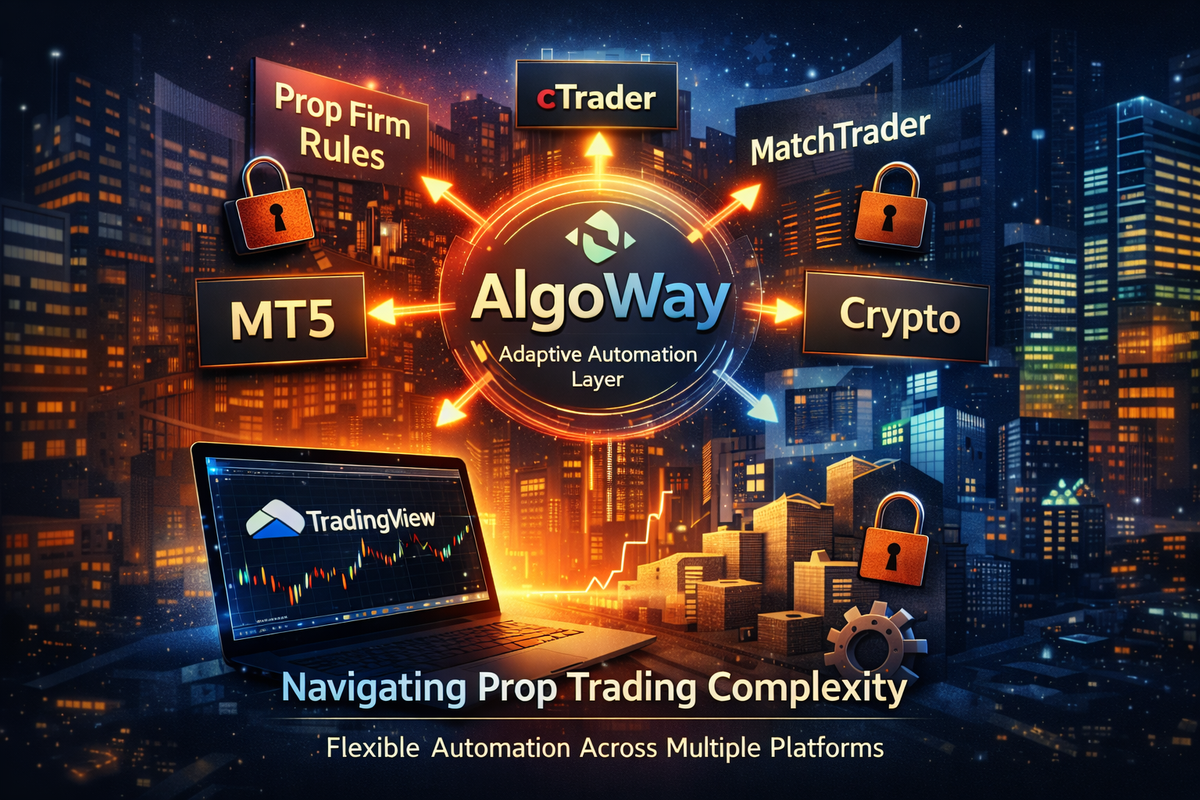
Prop trading in 2026 is no longer a one-platform world. Traders move between MT5, cTrader, DXtrade, Match-Trader, TradeLocker and other environments depending on the firm, account type and region. That fragmentation is exactly where AlgoWay fits. AlgoWay is built as a multi-platform automation layer for traders who need to route TradingView alerts into the execution environment that is actually available to them, not the one they wish every prop firm used. AlgoWay publicly positions itself around broad routing support and already lists more than 20 supported platforms across prop platforms, brokers, crypto exchanges and futures venues.
That matters because the real problem is no longer “Can TradingView send a webhook?” Of course it can. The real problem is whether a specific prop firm, on a specific platform, allows the exact route required to turn that alert into a live execution workflow. A platform can be technically automation-capable while the firm using it still blocks the path you actually need. cTrader has a public Open API, DXtrade publishes API access, Match-Trader offers a Platform API, and MetaTrader 5 is built around Expert Advisors and automated trading. But Match-Trader also explicitly states that API functionality can be selectively disabled by the operator, which is the clearest possible reminder that technical capability and practical availability are two different things.
This is why AlgoWay’s value is not “we support many logos.” The value is flexibility across firm-specific restrictions. One trader may have a prop setup where MT5 is the cleanest route. Another may find that cTrader is the most workable environment. A third may discover that a platform is listed on the website, yet the practical automation path they need is closed, limited or simply not worth building around. In that market, the winning automation stack is not the one with the prettiest platform list. It is the one that helps the trader find a route that is actually usable, compliant and stable.
The platform name is not the rulebook
A lot of traders still ask the wrong question. They ask, “Does this firm have cTrader?” or “Does this firm offer DXtrade?” The better question is: “On this exact firm, on this exact account type, does my workflow remain allowed?” FTMO is a good example. FTMO publicly offers MT4, MT5, DXtrade and cTrader, and it also states that algorithmic trading and EAs are allowed as long as the strategy stays within its rules and does not drift into forbidden trading practices. But FTMO also makes clear that third-party access and cooperation that effectively hands control of the account to someone else are not acceptable. So FTMO is not simply “pro-automation” or “anti-automation.” It is better described as automation-permitted within a controlled, trader-owned framework.
Alpha Capital Group makes the distinction even sharper. Alpha Capital allows copy trading only under controlled conditions and states that copy trading on or from cTrader, DX Trade and TradeLocker accounts is not possible at this time. It also says EA functionality is currently available on MT5 only and requires pre-approval. This is exactly the kind of rule split that traders miss when they look only at platform branding. Two accounts may both belong to “modern prop platforms,” yet only one of them may be viable for the external TradingView route you want to run.
FundingPips shows a different pattern. Its terms prohibit copy trading or account management by a third-party vendor, while allowing third-party Expert Advisors under stated conditions. On the cTrader prop-firm listing, FundingPips is described as permitting trade copying between accounts belonging to the same individual. That is not a blanket green light for every automation model. It is a firm-level filter: self-controlled automation looks far more acceptable than outsourced copying or vendor-managed execution. That distinction is exactly why traders need a routing layer that can adapt to different firm policies instead of assuming that one method works everywhere.
Breakout sits on the stricter side of the spectrum. Its public rules say that copy trading must involve your own trades and that copying third-party strategies, analysts or signals is prohibited. In plain language, the firm is not judging the platform logo first; it is judging the origin and ownership of the execution logic. That is a major reason why prop automation in 2026 has become a routing problem, not just a webhook problem.
The market is splitting into clear policy camps
Across the industry, the rules are starting to cluster into recognizable groups. Some firms allow self-owned copy trading or cross-account execution only if all accounts belong to the same individual. BrightFunded says copy trading is allowed between accounts held by the same person. Dominion Funding says copy trading is allowed with your own accounts, including other prop firms or brokers, as long as they are solely owned by you. BEM Funding says copying other traders is prohibited and that you must remain the sole manager of your account. These are not small legal details. They define whether a multi-account TradingView workflow is realistic or dead on arrival.
A second group is even more restrictive. FundedNext allows copy trading only under detailed conditions, limits it to same-owner structures, and separately says cloud-based copy tools such as Social Trader Tools, Traders Connect and Duplikium are not allowed in that workflow. Top One Trader goes further and says copy trading is strictly prohibited on certain funded account types. In other words, even if the trader has a technically valid automation method, the firm may still reject the structure because it looks too close to mirrored execution or external orchestration.
Then there are firms that allow automation only when it is clearly yours. Fintokei says custom-built EAs developed and fully controlled by the trader are allowed, while third-party EAs or bots not created or controlled by the trader are forbidden. The5ers similarly flags third-party EAs where many traders hold the same trades and explicitly warns about providers where the trader does not own the source code. That again reinforces the same conclusion: the industry is not banning automation as such; it is filtering for ownership, originality and control.
What traders complain about in practice
Community complaints line up with these policy frictions. They should not be treated as primary proof, but they are useful because they show where traders actually feel the pain. On Reddit, traders discussing Match-Trader explicitly mention that API access can be disabled at the prop-firm or broker level, which matches Match-Trader’s own documentation saying the API can be selectively disabled under server-license control. Separately, recent Reddit complaints around FundingPips include traders saying they were flagged or banned for copy-trading-related issues, which fits the broader industry pattern of aggressive enforcement around mirrored execution and third-party workflows.
This is the practical gap AlgoWay is designed to help solve. AlgoWay cannot magically override a prop firm’s rules, and that is not the point. The point is to give traders a flexible automation layer across many environments so they are not trapped in a one-platform mindset. If one prop firm works best through MT5, another through cTrader, and a third turns out to be unsuitable for the route you wanted, the answer is not to rebuild your whole TradingView process from scratch every time. The answer is to use an automation layer that can move with the market and with the firm-policy reality behind it.
Where AlgoWay becomes important
This is the part many traders underestimate. The real value of AlgoWay is not that it can route an alert from point A to point B. Plenty of tools can promise a connection. The real value is that AlgoWay is positioned for a fragmented world where traders may need different routes for different firms, different brokers and different platform families. In one setup, the workable route may be MT5 with an EA-friendly policy. In another, it may be cTrader with same-owner copying. In another, the platform may exist publicly but the practical external route may be too restricted to justify deployment. A trader needs optionality across those realities, not a single brittle bridge.
That is why TradingView automation for prop firms in 2026 should not be framed as “Which platform do you support?” The more serious question is: “Which firm-platform route is actually usable for the way I trade?” Once you frame the problem correctly, AlgoWay’s role becomes obvious. It is not just a connector. It is a practical routing layer for traders trying to survive a market where platforms are fragmented, prop-firm rules are inconsistent, and the gap between “available on paper” and “usable in practice” keeps getting wider.