Can There Ever Be a Linux Moment for AI?
Free software survived Microsoft. It survived the browser wars. It survived the rise of the cloud. But can it survive the age of artificial intelligence — or have the rules of the game changed for good this time?
When Linux appeared, the world did not simply get another operating system. It got proof that a community could build a foundational technology that did not belong to a single corporation, was not locked inside a single datacenter, and was not governed by a license that could be rewritten tomorrow. Linux became a symbol of the idea that freedom in technology could be more than a romantic dream — it could be a working model.
Today, many people want to see the same kind of moment emerge in AI. It is tempting to believe that sooner or later a “free AI” will appear and follow the path Linux took: open code, an open ecosystem, thousands of contributors, independent development, and a de facto standard. The question is whether that scenario is possible at all.
The problem is that the age of AI is built differently.
In the world of classic open source, the key resource was source code. If the code was open, it could be studied, modified, compiled, run locally, and redistributed. That was enough for a project to develop a life of its own. That is exactly why Linux was able to grow from a student initiative into the foundation of the modern internet, servers, clouds, and infrastructure.
With AI, code alone is not enough. Model code by itself means almost nothing without the weights, without the data, without the training pipeline, without fine-tuning, without evaluations, without filtering systems, and without the compute infrastructure behind it. You can publish the repository, but that still will not be enough to reproduce the result. If source code was almost everything for Linux, in AI source code is only the shell.
This is where the main difference begins. Freedom in AI no longer depends only on licensing — it runs straight into economics. The best model today is not merely an algorithm. It is millions or billions of dollars in hardware, energy, engineering teams, data, compute clusters, continuous inference, post-training, monitoring, and an enormous improvement cycle. AI has turned out to be much closer to the semiconductor industry or cloud infrastructure than to the era of GNU and early Linux.
That is why many people are beginning to ask an uncomfortable question: was AI the moment when free software finally hit a barrier that cannot be overcome by enthusiasm and good code alone?
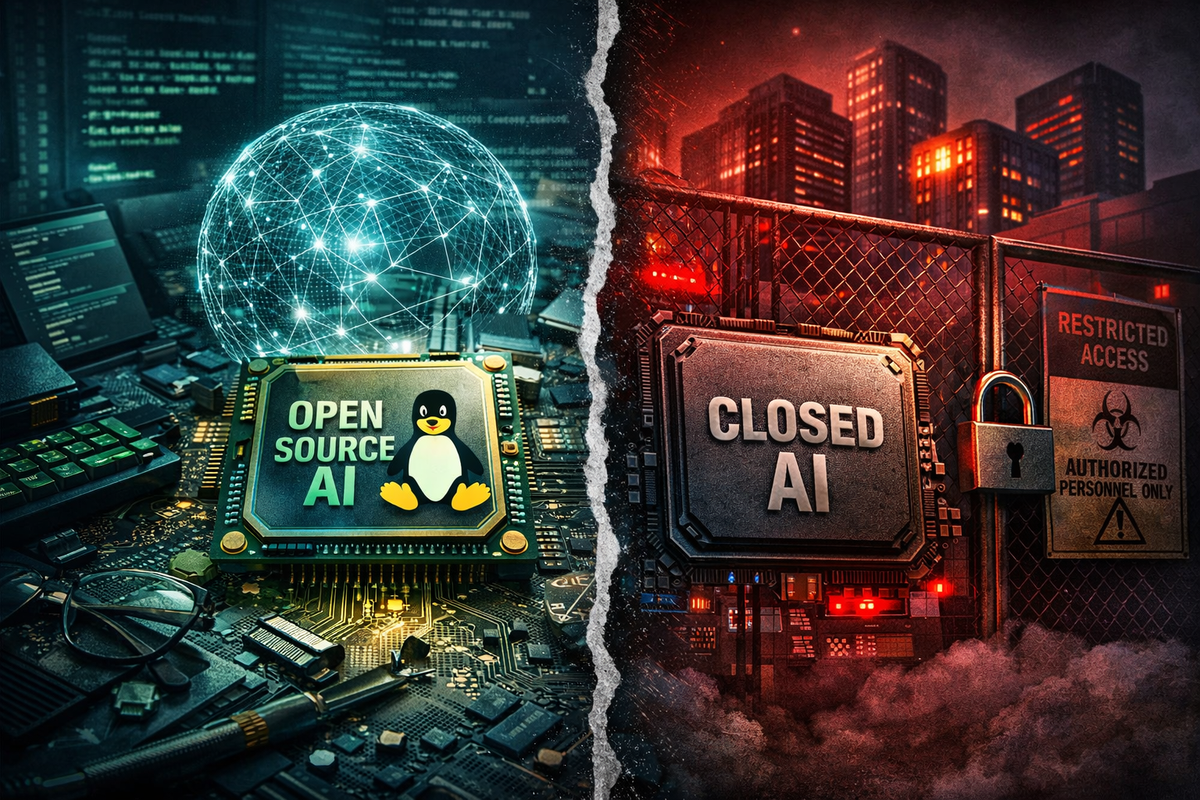
At first glance, it seems that the answer is yes. The best models are closed. The best weights are not released. The best products run as services, not as software you can install and operate yourself. The user does not get control — only access. And that access can be restricted, monetized, revoked, censored, or changed at any moment. In that model, freedom is replaced by subscription.
That really does look like a radical departure from the spirit of open source. The internet once gave people the ability to run their own servers, their own websites, their own services, and their own stacks. Closed AI is pushing the market in the opposite direction: do not deploy it yourself, call an API; do not own the tool, rent it; do not study the system, trust the black box. If that path becomes permanent, what we will have is not an open web enhanced by AI, but a new version of the old centralized world, where the core intellectual infrastructure belongs to a handful of labs and their cloud partners.
But that is not the end of the story.
Because a Linux moment for AI, if it comes, will most likely not look like a direct copy of Linux. The mistake is to expect one project to emerge, unite everyone, beat everyone, and become the universal free standard. That may never happen. But that does not mean free AI is impossible.
It simply means its form will be different.
If free AI wins, it will not win as one monolithic project. It will win as a stack. That stack may include open weights where possible, open inference engines, open fine-tuning tools, local execution, open agent layers, open protocols for interaction between models, tools, and user data, and above all, the right to run all of it without asking permission from a central authority.
In other words, the new Linux moment for AI will not be “here is our Linux.” It will be “here is our new open layer of independence.” Not a single repository, but an ecosystem in which no one controls the whole thing.
That process has already begun. Open-weight models are getting stronger. Local inference no longer looks like a toy only for enthusiasts. More and more companies and developers want not just the best answer from a model, but predictability, autonomy, control over their data, and independence from someone else’s policy. Wherever control matters to a business, demand for free and local AI solutions will keep growing.
But one thing has to be admitted honestly: even in the best-case scenario, the world of free AI will not be as simple as the world of free software was twenty years ago. It will be heavier, more expensive, and less romantic. It will not emerge from ideology alone. It will need infrastructure, money, and persistence. It will need not only developers, but also people willing to support compute independence, build open datasets, maintain local runtimes, reduce the cost of inference, and create tools that can actually be used rather than merely discussed at conferences.
So, has the final nail been driven into the coffin of free software?
No.
But AI has, for the first time, forced the open-source world to confront the fact that freedom in technology is no longer just about publishing source code. Freedom now has to be secured at the level of models, compute, protocols, deployment, and the right to run systems independently. That is far more difficult. But that is exactly why the real struggle is only beginning.
Linux proved that an open system can beat a closed one. The age of AI will test whether society can repeat that principle in a world where power is concentrated not only in code, but in GPU clusters, model weights, and someone else’s datacenters.
And the main question today is no longer whether AI can have its own Linux moment.
The main question is whether the world still has the will to build it.