Why We Prefer EA and VPS Over Cloud Execution for MT5
We analyzed the trade-offs of EA and VPS versus cloud execution for MT5 and prioritized security and reliability in our trading operations.
In retail algo trading, “cloud execution” sounds elegant: TradingView sends a webhook, a remote service receives it, and your trade is executed without running MetaTrader on your side.
It sounds clean. It sounds modern. It also hides important trade-offs.
We tested this direction ourselves. In practice, for MetaTrader 5, cloud execution is not magic. It is usually a hosted terminal architecture: a provider runs and manages MetaTrader instances in its own infrastructure, then exposes an API layer on top. That is also how third-party platforms in this category present their service model. For example, MetaApi documents that cloud trading access requires trading account credentials, and their deployment process explicitly starts an API server and a trading terminal for the account.
There is no public “secret MT5 cloud protocol” for normal users
MetaQuotes does offer APIs, but the official server-side APIs are positioned for brokers and infrastructure operators, not for ordinary end users who want to trade from TradingView without a terminal. MetaQuotes lists Manager API, Gateway API, and Server API on the broker side, while its official Python integration connects to the MetaTrader 5 terminal itself.
That distinction matters.
If a retail service claims “MT5 cloud execution without you running a terminal,” the practical implementation is usually one of these:
- Hosted MT5 terminals in the provider’s infrastructure.
- A third-party cloud layer that still deploys and controls MT5 terminal instances behind the scenes.
So the real question is not whether the trade is executed “in the cloud.”
The real question is: who controls the terminal, who stores the credentials, and what happens under load?
The credential problem is real
To trade on an MT5 account, a cloud provider generally needs trading access. MetaApi’s documentation states that the password for trading features can be the master password, while investor password is for read-only access.
That means a user is no longer just connecting TradingView to a bot. They are handing trading credentials to a third party or entering them into a third-party controlled onboarding flow. MetaApi even documents configuration links where the end user enters login and password, and password changes trigger redeployment of the account infrastructure.
This does not automatically mean the provider is malicious.
It does mean the trust model changes completely.
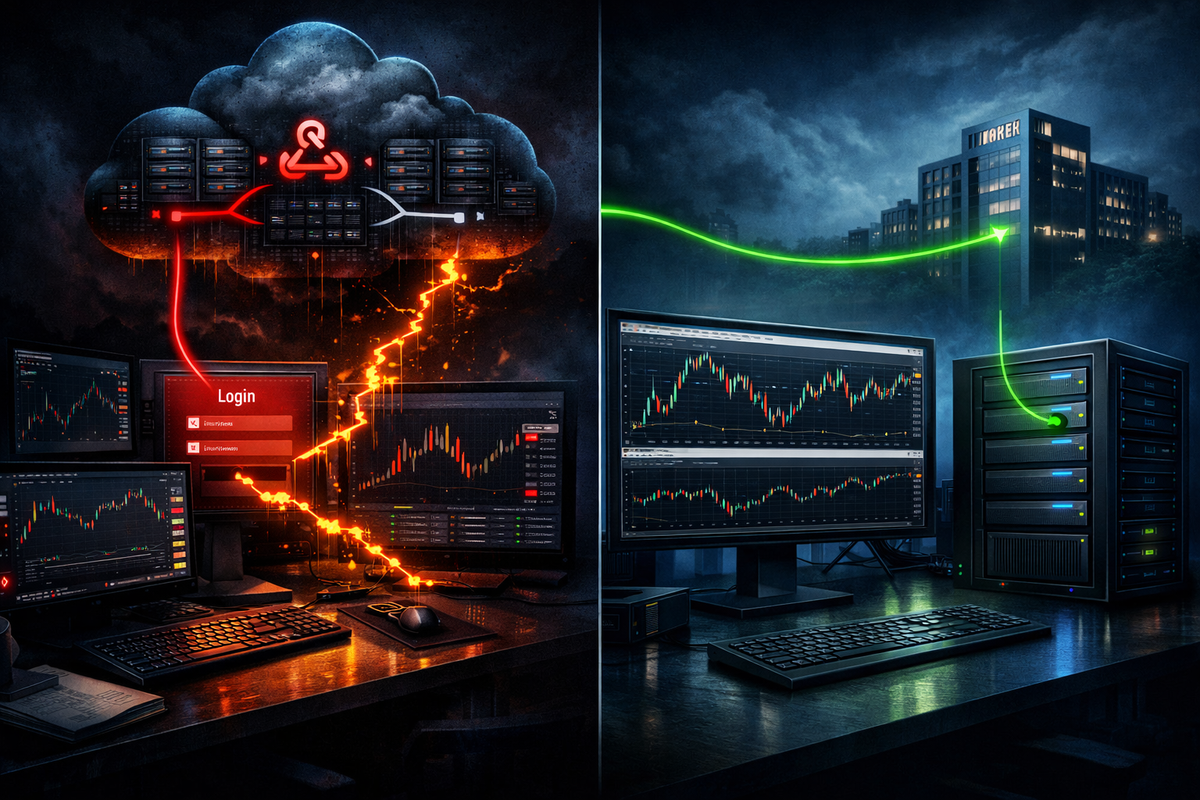
When you use EA + VPS, the trading password stays inside the trader’s own terminal environment. When you use hosted cloud execution, the credentials — or an equivalent trading authority — must exist inside somebody else’s infrastructure.
For serious traders, that is not a cosmetic difference. That is the core security boundary.
Webhooks do not solve execution reliability
TradingView webhooks are just delivery events. TradingView documents that alerts are generated on their servers, and webhook requests are sent to your endpoint with technical limits such as accepted ports 80/443 and a processing timeout of roughly 3 seconds.
So a webhook is not execution.
It is only the beginning of execution.
From that point forward, speed and stability depend on the receiving side:
- queueing
- auth validation
- parsing
- routing
- order submission
- terminal state
- broker connectivity
If that receiving side is a multi-tenant hosted MT5 farm, then your order quality depends on how well that provider provisions compute, isolates tenants, handles bursts, and recovers from failures.
The scaling problem is structural
This is the part many marketing pages skip.
MetaTrader is not a lightweight stateless microservice. In cloud architectures that emulate “terminal-less” trading for MT5 users, somebody still has to run terminal processes or equivalent session logic at scale. Even vendors in this space describe deployment, replicas, regions, and cloud API servers per account.
That creates a structural risk:
- during quiet hours, consolidation looks efficient;
- during volatility spikes, latency margins shrink fast;
- if many accounts act at once, contention increases exactly when execution quality matters most.
We know this because we tested this route ourselves and hit the same wall: Windows-based VDS fleets become resource-sensitive much faster than marketing suggests. That is why we chose not to build Algoway around centralized hosted MT5 execution.
Single point of failure vs isolated failure
A centralized cloud execution service concentrates risk.
If their infrastructure has an outage, deployment issue, routing bug, regional problem, or overload event, many users are affected at once. By contrast, with EA + VPS, failure is isolated per user environment. One VPS can fail without taking down the rest of the customer base.
Cloud advocates call centralization “managed convenience.”
That is true.
But the other side of the same design is shared failure domain.
Why we chose EA + VPS
Our decision was not ideological. It was technical.
We chose EA + VPS because it gives the trader:
- local control over the MT5 terminal
- a cleaner security boundary for trading credentials
- isolated runtime per user
- predictable execution path
- less dependence on a shared multi-tenant terminal farm
TradingView still works perfectly well as a signal source. Alerts are generated on TradingView servers. But for the final execution layer, we believe the safer and more robust model for MT5 is: your terminal, your VPS, your broker session, your control.
Final point
“Cloud webhook execution” for MT5 is not magic.
It is infrastructure.
And once you strip away the marketing, the real trade-offs become obvious:
- convenience vs control
- shared infrastructure vs isolated runtime
- outsourced credentials vs user-owned terminal environment
For us, EA + VPS is the more honest architecture.